Wednesday, August 17, 2022

Back In the Saddle - Star Trek Adventures

Let me tell you about the RPG campaign I'm running!

It's been awhile since I've run any kind of tabletop game for a group. The last one was canceled in 2020 and starting a new one didn't happen for a variety of reasons. Remote gaming didn't appeal to my group, but we did keep in touch over Discord. A number of folks in our group were holding down medical or public-facing service jobs, so in person gaming kept getting pushed back.

That all changed recently when we decided to get the band back together.

Last minute cramming before Session Zero!

Early Discussion

The idea of returning to in person gaming came up over Discord and shifted over to picking out a game. The field got narrowed down to Star Trek Adventures, 13th Age, and Conan: Adventures in an Age Undreamed Of. The majority of the players are involved with an ongoing Dungeons & Dragons 5e campaign, so any form of F20 seemed redundant to them. Conan was ruled out since I didn't have a firm idea for a campaign other that a series of "throw stuff at the players and see what they like" adventures. With everybody being a Star Trek fan, the emergence of a variety of new content for that franchise coming out over the past few years, and my ability to come up with adventure ideas, Star Trek Adventures seemed like the best bet.

Now, I know what you might be thinking: "Star Trek Adventures? That's Undiscovered Country for the Over the Hill Gaming Blog!" That's a fair point. After all, I've only written about a couple of dozen posts concerning the game. I'm clearly not primed to run the game, but I'll just have to do my best and muddle through it somehow.


Session Zero (And Change)

The next step was getting together - in person - for Session Zero. The actual Session Zero got cut short due to scheduling issues. So we actually had Session Zero and Session Zero and Change. I usually run Session Zeroes with two major topics in mind - campaign discussion and character generation. Star Trek Adventures adds a third - starship generation.


Campaign Discussion

The first Star Trek Adventures campaign I ran for this group was strongly influenced by DS9. It was placed along the Cardassian border. The Bajorans, Cardassians, Maquis, and Dominion all featured regularly. The themes revolved around the kinds of conflicts and dilemmas depicted on DS9. It all worked well overall, but the darker tone and untangling complex issues fatigued the players. A change was in order.

The next one was a soft reboot of the first. Certain plotlines and characters carried over, but the campaign was set on another starship with a mostly newly introduced crew. The location was moved away from the Cardassian border. The themes and tone was shifted over to exploration and frontier diplomacy. Unfortunately, that campaign was canceled shortly after it started due to the situation in 2020.

We briefly talked about alternatives to the standard Star Trek Adventures set up of the player characters being a Starfleet bridge crew. Star Trek Adventures does support other campaign concepts such as running a stationary installation. The Klingon Empire Core Book presents the nuts and bolts of running a Klingon campaign. However, this would be our first time back out in awhile, so we decided on the well-worn path of flying Federation colors.

This campaign is a fresh start - a hard reboot with no connections to our earlier Star Trek Adventures campaigns. We're starting over in the default year of 2371, a period with plenty of opportunities. Things are kicking off in the Beta Quadrant - the familiar realms of Klingons, Romulans, and Orions. The initial themes are exploration and diplomacy, but things are expected to change as the timeline moves forward.


Character Generation

Most of both Session Zeroes were spent on discussing character ideas, making choices along the lifepath system, and filling out the details of each player character's background. I prefer to have all of players handling character generation as a group activity. It's handy to have a group to bounce ideas off of and brainstorm with when a player gets stuck when coming up with a character concept or element of their back story. It also helps to insure that everybody - gamemaster included - is on the same page.

In Star Trek Adventures, I start things off by listing the senior officer positions on a whiteboard. The players divide them off however they want. I also reminded them that Supporting Characters exist as an option to cover any gaps or for a player to use when their character isn't in a scene. Once things got rolling, I took a backseat - answering questions and helping when requested, but otherwise letting the players work at their own pace.


The NPC Captain

None of the players really wanted the role of the captain. I'd rather not force a role on somebody - myself included - and diminish their enjoyment of the game. I had a couple of issues with the idea of a NPC captain, but agreed after ways around the issues were found.

Making the authority figure a NPC potentially takes decision making away from the players. With a NPC calling the shots, they may end up dragging the player characters through the story as spectators. The most direct way of avoiding this is a passive captain, but that doesn't make much sense for an experienced professional in a leadership position. Our solution involves stopping the game during key decision points to allow the players to discuss what direction to take things. When play resumes, the NPC captain then proceeds as if they made a decision that matches what the players decided on.

Most iterations of Star Trek have the commanding officer as the series lead. Authority figures tend to pull focus. It's one thing to have various NPCs pop up and depart as we move through an adventure. Even NPCs who show up regularly don't present a problem. It's another matter entirely to have a NPC with authority over the player characters show up in almost every scene. It's just too easy for such a NPC to overshadow the player characters in the context of Star Trek. If aliens call the ship, they're going to want to talk to the captain. That can easily cut the players out of participating in the conversation, making them passive observers. Most players show up to play the game, not watch it unfold. Fortunately, Star Trek canon provides a partial solution - the captain doesn't go on Away Missions. I'll be designing the adventures to take place off the ship as much as possible.


The Cool Starship

We turned to one of the few canon starships that's a blank slate outside of its only on screen appearance - USS Phoenix (NCC-65420). The ship disappears from canon after showing up in "The Wounded" (TNG 4x12). Not even the comics, novels, video games, and other beta canon revisits the ship. This is unusual since Star Trek writers regularly reuse ship names to tie the story they are telling to earlier episodes. For example, USS Cairo is introduced in "Chain of Command, Part I" (TNG 6x10). It is stated to still be in the area and responding to the current crisis in the following episode "Chain of Command, Part II" (TNG 6x11). Much later, USS Cairo is believed to be destroyed in "The Pale Moonlight" (DS9 6x19).

USS Phoenix played a part in both of the previous campaigns. One of the player characters in the former campaign was an officer aboard USS Phoenix during the events of "The Wounded" and had a black mark of their record as a result. The ship was to be featured in the latter one, but didn't get far due to that campaign's cancellation.

For the purposes of this campaign, USS Phoenix was moved away from the Cardassian border after the arrest of Captain Benjamin Maxwell. The ship was repaired while the senior officers were investigated for their roles in the incident. USS Phoenix was eventually reassigned to the Beta Quadrant and served under a different captain for a couple of years and was pulled in for a refit. The newly refitted starship is now ready for duty under a new captain and crew.


With Session Zero (and a half) done, we're ready to get started. I'm in the process of putting together my ideas into something halfway coherent. The first adventure will likely start in a couple of weeks. In the meantime, I hope that this post has been entertaining and offered some handy ideas and insights.

Monday, August 15, 2022

Trash Bash Sci-Fi Fuel Drum

This was a quick and dirty proof of concept I threw together over a hot summer afternoon. The goal was to see what else I could do with a couple of plastic soda bottle caps other than make another wheel for a sci-fi vehicle. It could be almost any kind of sci-fi widget, but I'm going to develop it as a sci-fi fuel drum for 28mm tabletop gaming. The execution needs more refinement before I crank out a bunch for scatter terrain.

One thing I can't complain about is the cost of the parts.

Parts List
  • Plastic soda bottle caps x 2
  • Coffee bag valve x 1
  • Plastic beads x 3

Preparation

The soda bottle caps and coffee bag valve got a good scrubbing with warm soap and water. Then I sanded down the edges and tops of the soda bottle caps. The edges were pretty rough and I wanted to improve how well they fit together. On the other hand, the tops were too smooth and I was concerned about how well glue, primer, and paint would bond to the surface.


Assembly

Pretty straightforward. I formed the main body by gluing the pair of soda bottle caps together. The coffee bag valve and beads were glued on what I arbitrarily decided was the top.


Spray Priming

Krylon Fusion All-In-One Matte Black

Coated all surfaces, including the underside.


Spray Painting

Krylon ColorMaster Paint + Primer Metallic Aluminum

A single coat. Since this was a proof of concept, I didn't feel the need to go further with the paint job. Later iterations will get a coat of wash and some details painted with a brush.


Moving Forward

It's good enough for a proof of concept, but there are some issues that I'll need to fix in the next iteration. I didn't notice the lettering on the coffee bag valve until after spraying on the metallic coat. That will have to get removed next time. I might play around with the number of beads and find something else to add as a detail. Reducing the number of beads from three to two would match the number of openings on a real world fuel drum. Adding an angular bit would contrast with all the curves everywhere else. Finally, I'd like to try another color for the base coat.

Monday, August 1, 2022

Trash Bash Monowheel Cycle FINISHED

Here's a monocycle model I cobbled together from reclaimed materials. It started off as an experiment with making a wheel with a pair of plastic soda bottle caps and grew from there. When I last posted about this project, all I had left to do was put it on a base and paint it up. Finding my way forward took awhile.

Rosie inspecting some Atmospheric Water Condensers during her frontier days.

Basing

I started by attaching the model to a round plastic base with Gorilla Super Glue. This bond was only intended to hold everything together long enough to apply texturing mix to the base. The mix of sand, PVA glue, paint, and water that I favor sets like concrete once dry. The combination of Gorilla Super Glue and texturing mix produces a strong and durable bond.


Spray Re priming/Base Coats

Krylon Fusion All-In-One Matte Coffee Bean Paint + Primer
Krylon Camouflage Ultra-Flat Khaki

At least one more coat of spray primer proved necessary when I ran into problems painting the wheel black. The Tamiya Surface Primer didn't seem to bond properly to the plastic soda bottle cap. The Krylon Coffee Bean covered well and provided a flat, dark brown base coat. I followed up with Khaki sprayed in a zenithal pattern.

A little dirty and dusty, but still purrs like a kitten.

Painting

Wheel

FolkArt 479 Pure Black

A couple of coats over the entire wheel surface to represent rubber or some sci-fi substitute.


Body

FolkArt 437 Lipstick Red
FolkArt 932 Calico Red

I considered yellow or orange for the body, but went with red for the speed boost. Lipstick Red works as a dark base color and Calico Red as a highlight color.


Clean Up

FolkArt 231 Real Brown

I changed my mind about where some of the red went and gave those areas a coat of Real Brown. The dark brown produced a good undercoat for the metallic and cloth areas.


Metallic Areas

Citadel Colour Boltgun Metal
Citadel Colour Mithril Silver

I don't know how, but these old bottles are still going strong. The Boltgun Metal coated the areas representing bare metal parts with Mithril Silver lightly brushed over as a highlight.


Cloth

FolkArt 420 Linen

Linen seemed like a good choice for the sandbag seat cushions and the bags in the stowage area.

The only thing kept clean on this ride is the holographic projector for the HUD.

Weathering

FolkArt 479 Pure Black (diluted with water)
FolkArt 231 Real Brown (diluted with water)
FolkArt 420 Linen

The monocycle is supposed to be made of salvaged parts – much like the actual model - and used in the wastelands of some frontier world. A showroom new appearance didn't seem like the right move. The diluted Pure Black and Real Brown were each applied as wash coats. A heavy brushing of Linen produced a dusty appearance. If I do another project like this, I might use a Silver Sharpie to add some chipped paint and other details before applying the washes and drybrushing.


Base Clean Up

FolkArt 231 Real Brown
FolkArt 420 Linen

I needed to cover up some of the red paint that ended up on the base. This step also ties the ground colors to the weathering colors.


Wire

Adding a wire to connect a couple of the parts together was always part of the plan. Unfortunately, I forgot about it until everything was painted, but before I started weathering the model. Fortunately, the wire color works with the rest of the model and the wash coats help to tie it in.


Heads Up Display

The final step was to attach one of the Warsenal Fluorescent Scifi Screens I purchased way back in 2020 to the part representing a holographic projector.

Rosie: "Now where did I pack that screwdriver?"

Fictional Background

Let's wrap up with another Kessler's Catalog entry. I often think of how elements of a model would fit into a fictional setting while working on it. Writing these thoughts up into a backstory gets them out of my head.

This monowheel vehicle is representative of those used in remote regions of thinly settled worlds throughout the frontier sectors. Such vehicles serve a variety of operators such as couriers, surveyors, salvagers, and scouts. Packs of similar vehicles see use in conflict zones as raiders.

The chassis is built on the remains of a planetary survey probe. The wheel was salvaged from the landing gear of a heavy interplanetary transport. The other components originated from sources to varied to be listed here. Reliability is surprisingly high, but some maintenance tasks are described as "a bit tricky" by our technical staff. Performance is good, but handling "takes some getting used to" according to our test drivers.

The wheel is a plastic drum with a synthetic rubber coating and a metallic core. It is electromagnetically suspended and rotated when the vehicle is in operation. Stability and control are provided by a variety of counter gravity and mass manipulation systems. While these systems reduce the effective mass of the vehicle while operating, true flight is not possible due to their limited output.

Energy storage is provided by a series of repurposed power packs distributed throughout the vehicle. These packs are tied into a single system and can be replenished at any standard recharging station. The large solar energy collection arrays standard for planetary survey missions are missing - likely removed and repurposed long ago.

Auxiliary power is supplied by an internal combustion engine designed for planetary exploration and colonial applications. The engine can burn a variety of hydrocarbon fuels, but is most efficient when using high octane synthetic gasoline or alcohol. There is evidence of another auxiliary power system based on a nuclear generator, but most of the components are absent.

- Kessler's Upcycling Sales Catalog

Tuesday, July 19, 2022

D&D Beholder Miniature Rebasing

I was reminded of a problem with this Beholder miniature after using it on the thumbnail for the "The AD&D Monster Manual (1979) A - Z: Episode 3: "B - Baboon to Beholder"" video. Basically, the material used for the base is too soft for the job.


Replacing the base was a quick and fun project. This video provides an overview of the process.

Thursday, June 23, 2022

Coffee Bag Freebie Greeblies

A quick video about a couple of bits useful for trash bashing salvaged from an empty coffee bag.


Since the video came out to 41 seconds, I decided to play around with the Shorts format for this one.

Friday, June 17, 2022

7 Distress Calls to Start a Space Horror Game

Nobody can hear screaming in space, but distress calls seem to get through just fine. Distress calls have a long history in sci-fi horror stories set in space. A prominent example is Alien (1979, directed by Ridley Scott and written by Dan O'Bannon), which started a franchise with a transmission that turned out to be a warning. The highly regarded sequel, Aliens (1986, written and directed by James Cameron), is built around the "we lost contact, go find out what happened" variant of the trope. Here are seven ways to lure in a group of player characters in a role playing game or begin the narrative for a miniatures wargame scenario.

Just go out there and find out what happened. Easy money, right?

"Guilty Consciousness"

A freighter reported as missing and presumed lost is tracked drifting through a remote star system. No life signs and minimal power readings are detected. Long range observations indicate a hull breach, but the vessel is otherwise intact. The corporate owners send a salvage team to recover their investment. Naturally, things go south as soon as they get to the freighter.

The freighter suffered a debris collision that killed most of the crew on impact. The AI responsible for navigation went insane with guilt almost immediately. It was under orders to get the ship to its destination in the shortest possible time so that the crew could earn their bonuses. The captain had authorized transit through a high risk area to save time. The conflict between its orders and its safety protocols caused the AI to suffer severe psychological stress. The deaths due to the collision caused it to snap. It removed any witnesses by killing off the surviving crew and went on the run. The ship has been moving along minimum energy courses, conserving power, and only refueling at automated stations in isolated systems to keep out of sight.

Signs of its discovery and the appearance of salvage crew cause the AI to panic and lash out. The freighter is low on fuel, so it can't evade the salvage mission. However, it has complete control of the ship's automated security systems and will use them on any boarders. Handling the AI could take anything from an extended psychotherapy session to a sophisticated hacking attempt to spending a little time and effort in its processing core with a really big hammer.


"The Tools of the Other"

A private exploration ship returning from a long range mission has developed a technical fault. The audio-only request for assistance sounds almost bored as the voice describes a problem that could easily be repaired with the right part. Unfortunately, the expedition ran out during its decades-long mission. Should be an easy fix, right?

The transmission was weak, distorted, and garbled - the only things that experts could agree on was the source. A private exploration ship set off with its crew in stasis for the decade long voyage. When they arrived, they found the impossible - a duplicate of their own ship crashed on the surface of a dead world. Most of the team spoke of temporal anomalies and paradoxes, but one found answers in the wreckage. He found a journal and a few other items in the cabin of his Other. The journal, written in his own handwriting, told him what he needed to do. As the expedition prepared for the return trip, he reprogrammed his stasis capsule to awaken him early. The ship was still a year from home when he emerged from stasis and began the work of the Other. He awakened each member of the expedition, one by one, and murdered them using the Other's tools and following the rituals in the Other's journal. However, the work was not done. He made preparations, sent out a distress signal, and went back into stasis. The ship's computer will revive him when a ship approaches. He will be ready to receive any responding to his call. More sacrifices will be needed for the Other's plans.

The whole ship is rigged with traps to disable any who board it. The Other wants them to live long enough to die properly, after all.


"Servile Revolution"

Ideally, a new settlement should have as much infrastructure in place as possible before the majority of the population shows up. While the initial survey teams often face many challenges, the work of the construction crews who follow them is usually mundane. The process mostly involves assembling pre-fabricated structures and is assisted by automation. It comes as a surprise when one such effort stops reporting on the edge of explored space. The settlement's sponsors dispatch a ship to investigate.

It turns out that the work of setting up a new settlement got a little too routine and this particular construction crew sought out novel ways to deal with their boredom. One bright spark started running pit fights between construction robots modified by teams of technicians. To keep things lively, teams began to incorporate self-improving intelligences and augmenting the local wildlife into cyborg combatants. Some of the artificial gladiators were made self-replicating to cut down on build time. Naturally, the newest creations became a little too smart and got ideas about how to shake up the order of things. The construction personnel now only survive as parts in the descendants of their own creations. The place is now host to a self-replicating population of dangerous cyborg creatures optimized for close combat.

It would take a significant infantry force to clear out the settlement and make it safe for human habitation. A less brute force approach might take the form of a virus - software, biological, or both - targeting the former gladiators. Or the team sent to investigate might decide to nuke the site from orbit as the only way to deal with the threat. Of course, that team would have to survive long enough to escape back into space.


"Unwelcome Passenger"

The new FTL drive is a revolutionary development. It offers longer range and better performance with none of the drawbacks of older systems. The published results of all tests to date are positive, but there are rumors of unreported difficulties. Even so, the prototype installed on an experimental ship is sent out for testing. The first full power test ends with the loss of all communications. Long range scans detect the ship near its target destination. A spacial anomaly is also detected at the same coordinates. The ship is adrift, power readings are minimal, and there are no signs of life. A rescue ship is sent to recover the expensive hardware and find out what happened.

Any boarding team soon discovers that the corridors and compartments of the ship extend beyond the ship's external dimensions. The new areas are obviously of alien origin. Scraps of bloody uniforms and a few bones are all that's left of the crew.

The full scale test opened a door to somewhere else and attracted the attention of something living on the other side. Always hungry, it crossed over, consumed the fleshy things it encountered, and made itself at home. Now fresh prey is at hand.

Weird sculpture with strange writing? Nothing suspicious here. Ship it!

"Never Dig for Miskantonic U"

Miskantonic University regularly sponsors xeno-archaelogical expeditions throughout known space. Many proceed without incident, quietly expanding humanity's knowledge of ancient extraterrestrial cultures. Contact with some expeditions ends mysteriously and later investigation reveals abandoned camps and missing personnel. The last word from others are urgent messages - sometimes spoken in strange languages - stating that something has gone horribly wrong before getting cut off.

One example is the expedition lost while surveying the cyclopean ruins of a world scoured of life by a nearby gamma ray burst. The camp is in good order with all atmospheric seals intact. It's as if every single expedition member just got up and left at the same time. The only clue is the last entry in the expedition log mentioning something about an artifact found in the ruins. The entry describes a bizarre sculpture carved from green-black stone.

Another example is the expedition sent to explore a vast repository of knowledge taking up most of a newly discovered planet's surface. Regular uploads of data are cut off by a panicked report of hostile beings approaching the camp site. The location could be orbiting the star Celaeno or be a Yithian library. Either way, both the staff and the non-human patrons don't view the expedition or would-be rescuers favorably.


"Runaway Growth"

A passenger transport ferrying workers from a remote mining outpost emerges from FTL. An automated distress call indicates that it has suffered a reactor overload and radiation leak caused by a FTL drive malfunction. Life readings are confusing. There are no indications of human life, but something is still alive on the ship. Scans of the transport ship also indicate that it is running on emergency power. A rescue team is dispatched to investigate.

The ship was carrying samples of organic material discovered during routine mining operations. The mining outpost lacked the means to analyze it, so samples were placed in sealed containers and sent back with the workers. The organic material includes a colony organism of a type not previously encountered. The radiation leak penetrated the sealed containers and triggered rapid growth and mutations. The growth of the organism broke the seals on the containers and they escaped.

None of this was noticed by the crew and passengers, who had other issues. The FTL malfunction greatly accelerated the flow of time aboard the ship. There was no way for the supplies to last for the decades of relative time that the trip would now take. The crew began to work on ways to shut down the FTL drive.

Their efforts were overtaken by the spread of the organism. Efforts to contain it failed. The ship's medical personnel discovered that spores had moved through the life support systems and infected everyone aboard. The spores had also infected the food supplies and hydroponics bays. Already weakened by radiation exposure, the crew and passengers began to die from their infections. Strange creatures burst from the corpses to attack the dwindling survivors. Meanwhile, the colony organism continued to spread throughout the ship.

The decades of relative time allowed the organism to use the bodies, food, and other organic materials aboard to evolve into a full blown colony. Growths have spread throughout the interior of the ship. The drones that once collected resources for the colony are dormant in their cocoons. Any disturbance aboard the ship will alert the colony to new sources of organic materials it can consume and use to grow.

Was this on the manifest? What were they thinking?!

"A Taste of Forbidden Fruit"

An automated emergency beacon signal is received from a distant planetary survey team. The team was investigating the potential of a paradise-class world of lush, biochemically-compatible forests and jungles for settlement. All previous communications from the survey team were routine check-ins and progress reports. An expedition is launched to rescue the team and recover their findings.

The survey camp is in ruins and the team is missing, but the data systems can be salvaged. An initial search of the survey team's logs reveals:
  • All tests indicate that the native flora is safe for consumption. The team leader authorized using the native fruit and vegetables to supplement their food supplies.
  • Cataloging the local fauna is still proceeding. Reports of a large primate could not be confirmed. No member of the team was able to catch more than a glimpse of one.
  • Weak radio signals have been detected coming from a nearby magnetic anomaly. A group of volunteers would be deployed as soon as work schedules would permit.
  • Team morale is declining. The overall mood improved after the introduction of fresh food, but dipped back down quickly. Conflicts are escalating and tempers are beginning to flare. The team leader plans to focus the team's attention on investigating the radio signals to divert their attention away from internals conflicts.
  • A fair amount of survey data, but not enough for a complete report.

The rescue expedition has its first encounters with native fauna soon after arriving.

Deeper searches of the logs are possible, but require time to yield results:
  • An expedition was sent to investigate the radio signals and magnetic anomaly. The magnetic anomaly is the wreck of an obviously alien spacecraft and some nearby structures. The team determined that the hull of the spacecraft was partly disassembled and the components used to construct the nearby structures. The poor condition of the wreck and structures, along with the amount of overgrowth, indicate that they are centuries old. The source of the radio signals is a beacon inside the wreck using the last of its power.
  • The expedition had to be abandoned due to attacks from the native primates. The survey team was taken by surprise and several team members were carried off into the wilderness. None of the survey team was killed, but some sustained injuries. The team leader decided to pull back to their camp after an effort to track down the captured team members ran into further attacks.
  • Further survey team logs describe how the native primates have been systematically attacking the camp. The long range communications and remaining food supplies were specifically targeted, but none of the team were killed or seriously injured. Fortunately, the primates have not interfered with the team's efforts to forage for native fruits and vegetables. One particular fruit is noted as particularly delicious.
  • Barely enough survey data for a tentative report.
Hanging around the camp to recover more data, venturing into the wilderness, or going to investigate the alien wreck triggers an aggressive response from the native primates. They avoid killing - their goal is to take captives.

The final logs are corrupted and take time and effort to recover:
  • Discipline and morale within the team collapsed. Some members of the survey team became obsessed with a particular native fruit, gorging on it and trying to persuade others to give it a taste. They later banded together and attempted to force others to eat the fruit. They became aggressive when confronted and rebelled. They were last seen disappearing into the wilderness around the camp.
  • Efforts to forage for food have begun to come under attack.
  • Piles of the fruit have begun appearing near the camp. With other food supplies running low, the team will have to consume the fruit into order to survive.
  • The remaining team members are concentrating their efforts on defending the camp and repairing the emergency beacon. Hopefully, they can hold out until help arrives.
  • All of the survey data collected by the team.
There is a specific native fruit possessing addictive and transformative properties. Anyone eating the fruit quickly craves more and encourages others to partake. The fruit's effects slowly transforms those who consume it into a powerful primate that appears to be native to the planet. The primates already present when the survey team arrived are descendants of the aliens from the wreck. The captured survey team members were forced to eat enough fruit to begin the transformation. The rebellious survey team members left when they felt the transformation beginning. The last of the team were left with no alternative but to eat the fruit and transform. They left the camp soon after repairing and activating the emergency beacon.


Hope y'all enjoyed these ideas! Let me know how they work out in play.

Wednesday, June 15, 2022

Reaper Bones 80008 Rosie, Chronotechnician

It's been months since I did anything with my Five Parsecs From Home campaign. Sizing things up, there's three things I need to continue and a substitute miniature for Lin is the easiest to check off the list. Lin, previously represented by Rosie, Chronotechnician from Reaper's Chronoscope line, failed to repair her signature Brutal Melee Weapon and will be wielding a more conventional weapon for the next fight. Fortunately, I received the Bones version of her miniature as a reward from the first Reaper Bones Kickstarter.

I didn't want to simply reproduce my previous paint scheme on this figure. First, it's boring. Second, a quick change of clothes along with the weapon makes sense for the character. Third, it would allow me to use the figure as a different character later on.

Lin's got a loaner weapon until her big wrench gets fixed.

Base

I glued the integral base to a spray primed steel fender washer. The gap was filled after painting the miniature with a variant on my standard basing mix. This variant adds black rather than brown craft paint to a mix of sand, PVA glue, and a little water to improve flow. Some gray drybrushed on after the basing mix dried completes the industrial look of the base.


Preparation

The same approach I use for all white Bones plastic. Details are at the end of this link.


Skin

Menoth White Base

This with a wash creates a pale skin tone. I've never been happy with this approach and moved away from it, but used it here to match the Chronoscope version I painted before.


Shirt

Reaper 09017 True Blue

This is a bright blue that coats well. As the shirt is a small, flat area, I didn't feel the need to paint any highlighting over what the wash I applied later would provide.


Weapon

Citadel Colour Chaos Black
Citadel Colour Codex Grey
Army Painter Warpaints Quickshade Dark Tone

Not the neatest or fanciest approach, but one that brings out the mechanical details.


Overalls

Reaper 09158 Olive Drab
Reaper 09177 Camouflage Green

These are darker and lighter versions of an olive green camouflage color. They work well paired as a base and highlight.


Leather

Reaper 09284 Lonestar Leather
Reaper 09110 Oiled Leather

This is the same combination I used for the leather on the metal version and has become my go-to for a base and highlight combination.


Hair

Reaper 09183 Cloud Pink
Citadel Washes Baal Red

Again, the same combination I used for the metal version. To my surprise, the Baal Red was still perfectly viable, but most red washes should work fine.


Wash

Army Painter Warpaints Quickshade Strong Tone

Everything except for the hair and weapon got a coat of this wash slapped on it. Again, this reproduces my approach to the metal version and remains how I paint Bones plastic.

Bones (plastic) version on the left, Chronoscope (metal) version on the right.

Chronoscope and (Early) Bones Comparison

This is a chance to compare the metal and plastic versions of the miniature. To my mild surprise, I haven't actually painted the same sculpt in two different materials before.

The details of the Chronoscope version are sharper and better defined when compared to the Bones version. This is the expected finding. The soft white plastic used in the initial waves of Bones doesn't seem to be able to retain fine detail like metal or the harder gray plastic that Reaper switched to later on. The difference in detail is significant. The face is less detailed and the goggles are a muddy mess. It made for a less pleasant painting experience as I kept hunting for details that I knew were there on the metal version.

A comparison between the metal and plastic versions is incomplete without discussing pricing. Here are the prices in USD at the time of this writing:

Reaper Bones 80008 Rosie, Chronotechnician $3.99 (USD)
Reaper Chronoscope 50016 Rosie, Chronotechnician $5.99 (USD)

The plastic version can be picked up for two-thirds the price of the metal one. However, two bucks isn't a huge price difference in absolute terms. It comes down to personal preference. Is the difference in detail worth paying a little extra? The Bones version wouldn't be my first choice as a hero miniature or display piece. Which material is the buyer more comfortable working with? Metal and plastic demand different approaches. A painter set up for one material may not wish to adapt to the other.

Bones (plastic) version on the left, Chronoscope (metal) version on the right.

Bones - even early Bones - do have a place. Most of my Bones collection is from the first Kickstarter and is therefore the white plastic from the beginning of the line. All of the ones I've painted are serviceable when painted to a tabletop standard. The majority of the figures are monsters or other opposition that will only be on the table as long as the players allow them to survive. Also, a Bones figure makes for a fun "rainy day" painting experience. The work goes quickly since I don't stress much about getting the best results possible like I might with a metal, resin, or higher quality plastic figure.

In the end, comparing this figure to its metal counterpart didn't change my option on early Bones miniatures. They are a cost effective option for the kinds of miniatures meant to be used in bulk. Orcs or zombies? Oh, yeah, I'm going for the white plastic Bones versions. Likewise, large miniatures are much more practical in any form of plastic when compared to metal. However, I'm happy to shell out a little more for a centerpiece miniature of metal, resin, or higher quality plastic that I'm painting to look the best I can manage.

Saturday, June 11, 2022

Trash Bash Pill Bottle Stasis Tube

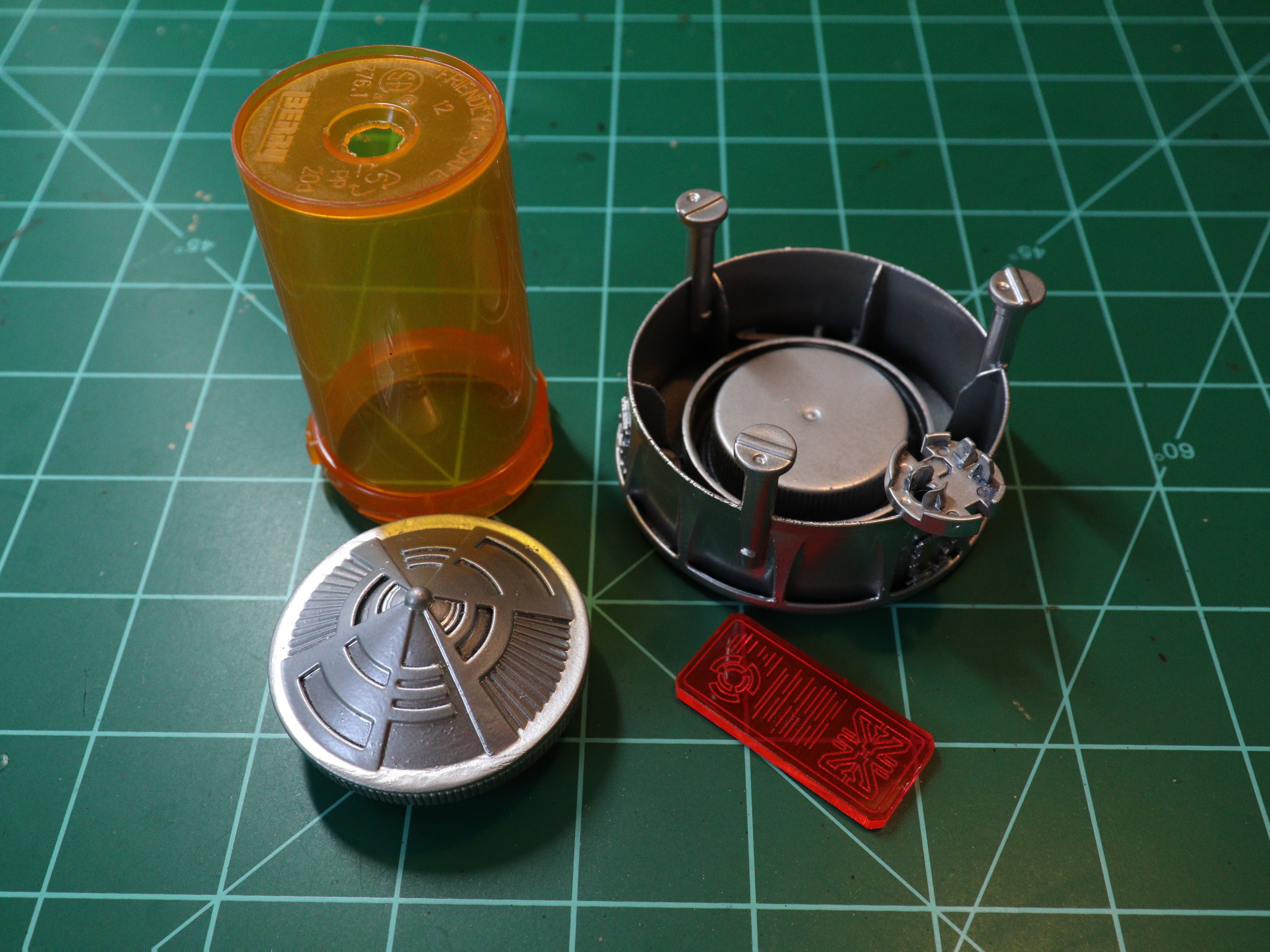
Awhile back, I made some Stasis Pods using pill bottles as a quick and dirty project. The idea behind this terrain is to be able to place a 28mm scale miniature inside and still see it through the transparent pill bottle. The original set met a sudden need for the campaign I was running at the time, but I knew I could do better. This is my second try at the concept.

Final test fitting. Just waiting for its first patient. Or victim.

Top Cap
This is a McDonald's Happy Meal toy from ages ago. I'm pretty sure it's a Star Wars themed spinning top. I wiped it down and realized that the protrusion would get in the way of mounting it on the pill bottle. I didn't relish the idea of cutting through the tough plastic of the toy, so I did the other thing.

Stasis Tube Body
A transparent pill bottle with the labels removed and cleaned with warm soap and water. I drilled a hole to accommodate the top piece's protrusion.

Mounting Hardware
The bottom piece is the cap from a juice bottle. I removed most of the threading to improve the fit of the pill bottle.

Initial test fit prior to painting.

Mounting Hardware Internal Platform
I glued a bottle cap inside the juice bottle cap to cover up some markings. It also raises up any figures placed inside the tube.

Display Panel
From a set of Fluorescent Scifi Screens from Warsenal. I purchased these awhile back to add exactly this kind of detail to my terrain projects. Not sure about the color, though. I'll try the blue and green options before gluing anything down.

Various Mounting Hardware Details
The towers are plastic clips of some kind. I don't recall the source. The round piece that I used to mount the display panel is a salvaged printer part. The square details were recovered from a nonfunctional keyboard. Finally, the parts glued inside to add some internal detail are the same as the ones I used as arms for the "Astromecha" robot. I may add some wires to simulate hoses running between them at some point.

Test fit after black spray coat.

Painting
The top cap and mounting hardware were spray painted black and then metallic. I then applied a dark wash, wiping off any excess with a sponge.

Major components after painting and prior to assembly.

Assembly
The spinning top and pill bottle fit together perfectly. It's almost snug enough to not require glue. Almost. The fit of the display panel is also good, but it will also be glued in place once I settle on the color. The pill bottle sits evenly in the juice cap and can be easily removed so that a miniature can be placed inside.

Tin Man Miniatures Princess Livia recovering from a beach trip.

I'm content with the results. but I still think I can do better. It's a more convincing terrain piece than the originals. It's missing something, though. I'll have to give it some thought and make another attempt later.

Thursday, June 9, 2022

Trash Bash "Astromecha" WIP

Something I threw together the other day. I was digging around in my bits collection for something else, noticed how well these parts fit together, and spent about twenty or thirty minutes building this robot miniature. Then I set it aside and got back to what I was doing in the first place.

Arms raised in threat, surrender, or just stretching?

In my defense, I've been considering cobbling together a trash bash robot for awhile now. I even collected a few images for inspiration. Maybe my brain seized on the first opportunity it came across.

Going from the bottom up to the top, the parts are:
  • A 25mm plastic slotted base. Pretty standard in the tabletop miniatures world. This particular one is from Games Workshop.
  • A pair of metal weights from a gaming mouse. Intended to customize the mouse to the exact specifications of the user. Salvaged after the mouse in question stopped working.
  • A plastic button from either a telephone or a fax unit. Again, salvaged after the unit they were once attached to stopped functioning. The plastic protrusions were clipped down so the mouse weight "wheels" would fit properly.
  • Three white plastic bits - the "arms" and "head" are separate parts. Printer salvage. I'm not sure, but I think they were paper feed roller parts from two different devices. How well the "head" fit on to the button "body" is what started this unplanned project.
  • The plastic "head" is hollow, so I glued in a flat sided plastic bead to partly fill the space.
Maybe not the droid she's looking for.

Everything is held together with Gorilla Super Glue. The bond with the base will be reinforced with my usual choice of basing material (sand, glue, paint, and a little water to improve flow) after the detail pass. The stuff sets like concrete. I'll just have to remember to tape the slot closed beforehand. Yes, I've made a mess by forgetting that step before.

The basic form is done. I've put off hitting it with a coat of spray primer until I can dive back into my bits collection and give it a detail pass. I'm hoping for an antenna or some access ports. Maybe something additional to fill in the empty "head" space. Until then, it's just not quite ready for painting yet.

Rear view showing the bead partly filling the space in the top piece.

More after I finish what I was working on in the first place and get back to this project.

Tuesday, June 7, 2022

Tin Man Miniatures Princess Livia

Presenting her royal highness, Princess Livia from Tin Man Miniatures. Tin Man Miniatures is best known for producing 28mm-32mm scale figures based on the Barsoom planetary romance series written by Edgar Rice Burroughs. This is the non-"A" version of the figure. The "A" version represents the same character, but wearing less than what is seen here.

Extraterrestrial beach attire.

Figures representing women clad more in concept than reality don't regularly feature on this blog, but this one has been in my unpainted pile for more than long enough. I picked her out of the pile since I was in a swords and sorcery mood after an involuntary month long break. Although "sword and planet" might be a better description here.

My first attempt ended with Livia taking a bath in Simple Green. I tried out a different spray primer and found that it went on too thick and obscured the finer details. Then the nozzle broke and I threw out the can. Worse, I didn't like how the paint scheme I picked out - pale skin and gold metallics - blended together.

Sometimes a fresh start is the best option. Besides, I need more practice with painting flesh tones. This wasn't the end of the challenges I ran into with this project, though.


Preparation

This figure required nothing other than the warm soap and water cleaning I give to all of my miniatures as a first step. I wasn't able to find any mold lines or flash.


Base Assembly

I decided that the small integral base is not fit for the purpose of keeping the figure standing upright. My solution is the same one I use for Reaper Bones miniatures - gluing the figure on a steel fender washer.


Color Scheme

I opted to paint this figure as a human rather than a Red Martian. No offense intended to Edgar Rice Burroughs, but I felt that I would get more utility out of a swords and sorcery appearance for this figure.

The warm colors of the figure's skin and hair contrast with the cold metallics of the figure's outfit and jewelry. The small amount of blue cloth continues the warm/cold contrast.

Hair flowing in the winds of an alien desert.

Spray Primer

Tamiya Surface Primer (L) Gray
Tamiya Surface Primer (L) White

Sprayed in a zenithal pattern. This worked much better for preserving the details of the model.


Skin

Reaper 09041 Dark Skin
Reaper 09221 Olive Skin
Reaper 09260 Bronzed Skin
Secret Weapon W005 Flesh Wash

I built up a tanned appearance from the Dark Skin base layer to the Bronzed Skin highlights. All of these paints work well as various skin tones. The wash added surprisingly little and I'll skip it the next time I use this recipe.


Hair

Reaper 09221 Olive Skin
Reaper 09257 Blond Hair
Secret Weapon W005 Flesh Wash

Using Olive Skin as a base layer meant one less paint bottle to dig around for. The wash was much more useful here, bringing out the flowing hair sculpted on the figure.


Metal

Citadel Colour Codex Grey
Citadel Colour Boltgun Metal
Citadel Colour Mithril Silver
Formula P3 Armor Wash

Metallic paints don't always coat well, so I started with a non-metallic base layer. Even applied as a highlight, the Mithril Silver overwhelmed the layers it was sitting on. The wash toned down the shine and brought back the details of the metallic areas.


Cloth

Reaper 09017 True Blue


Basing

The basing material is my usual mix of sand with water, PVA glue, and FolkArt 231 Real Brown to fix it in place. Next came a dry brush of FolkArt 420 Linen to give the surface a drier, sandy appearance. I used Citadel Colour Chaos Black for the rim and - judging by the photos - I'll need to touch it up.

The base still needs a little work, but good results overall.

The initial set of photos I took of this miniature revealed all of the flaws in my paint job. This wasn't the first time I ran into this issue, but it was the first time it was bad enough for me to go back, fix things, and reshoot. Most of the flaws were with the cloth and skin tones. Also, it was at this point that I applied the wash to the metallic areas since the reflections were giving my camera fits.

This project turned out to be more of a challenge that I anticipated. This is not the fault of the figure, which is well sculpted and cast. An unplanned month off from painting left me a little out of practice. Perhaps something else might have been a better choice for a first project back. On the other hand, I did come out with new recipes for painting skin tones and metallics. Overall, I enjoyed the process of finding solutions for the problems I ran into and extracting a figure from the unpainted miniatures pile.