Sunday, October 13, 2019

Star Trek Adventures - Felicity Cooke in Trouble

Let's continue with Star Trek Adventures by putting the computer specialist from a previous post into various kinds of trouble. These posts reflect insights gained from our USS Yamato campaign. I hope that passing on our impressions helps improve your experience with the game.

First, I'm going to give the "totally not a hacker" example a name - "Felicity Cooke" - and develop her from a concept into a fully playable character. A few minutes with the Star Trek Adventures online character builder gives me this:

Lieutenant Felicity Cooke

Species: Human
Environment: Isolated Colony
Upbringing: Science and Technology (A)
Assignment: Operations Manager

Attributes
Control 11          Fitness 8          Presence 8
Daring 9             Insight 9          Reason 11

Disciplines
Command 2        Security 3        Science 4
Conn 2               Engineering 4   Medicine 1

Values


  • "Nothing Can't Be Fixed"
  • "Call It Like I See It"
  • "Something to Prove"
  • "Some Rules Can Be Bent, Others Broken"

Talents

  • Resolute
  • Computer Expertise
  • Technical Expertise
  • Bold: Engineering

Focuses

  • Computers
  • Cybernetics
  • Electro-Plasma Power Systems
  • Espionage
  • Composure
  • Infiltration

Stress 14


The previous post established Felicity Cooke as having good ratings in the Engineering and Science Disciplines. Focus and Talent selection was driven by the "cyber information specialist" concept. The choice of Operations Manager as her bridge post is the closest that I could get to "information technology in SPACE" that I could get. Operations Manager does make good use of her abilities, as we will see.


Personal Combat - General Principles

So what happens when a Starfleet officer gets into trouble? Starfleet's policies usually call for deescalating conflicts whenever possible. However, Federation starships busy with boldly going and Away Teams exploring strange new worlds are routinely confronted by less idealistic organizations. Starfleet personnel are expected to be able to defend themselves in a dangerous galaxy.

Security is the Discipline that most directly determines how effective a character will be in personal combat.
  • Combined with the Control Attribute, Security determines how accurate a character is with a ranged weapon like their phaser sidearm.
  • Combined with the Daring Attribute, Security determines how often a character will land hits in hand to hand combat.
  • Combined with the Fitness Attribute, Security determines how many points of Stress a character can endure losing.

Putting a moderate number of points in Control, Daring, and Fitness and a fair amount of points in Security is prudent for a character who regularly takes part in Away Team missions. This approach results in a character who can take care of themselves without pulling too many points away from a core concept that may not be personal combat. On the other hand, a character who does have personal combat as a core concept - a Security Chief or other combat specialist - may wish to raise those Attributes and the Security Discipline as high as possible during character generation to reflect their training and experience. Finally, there are some characters who specialize in roles that keep them on the ship. This may result in a character who needs protection from others on those occasions when they do appear on an Away Team. There's nothing inherently wrong with this approach - Starfleet doesn't expect a Ship's Counselor, historian, or botanist to be a combat machine.


Personal Combat and Felicity Cooke

Felicity Cooke is an example of a character who was not created specifically for personal combat. Even so, she's not exactly helpless if a fight breaks out.

She has a Security Discipline of 3 due to some time spent with Starfleet Intelligence, who put her affinity with computers to use early in her career. Don't ask her about it, though - it's classified and she doesn't want to talk about it anyway.

Her Control Attribute of 11 makes ranged attacks her best bet for self defense. A Ranged Attack is a Control + Security Task with a Difficulty of 2. This means that she has to roll a 14 or below on a d20 to generate a success. She'll need 2 successes to hit. Since players normally only roll 2 d20s, she'll have to draw on Star Trek Adventures' metacurrencies (Momentum, Threat, and Determination) to get more dice. This is not unusual - the players should be watching for opportunities to generate those metacurrencies and the Gamemaster should grant those opportunities generously. Star Trek depicts Starfleet officers as succeeding more often than failing (to the point where failure sometimes becomes a story element) and the game models their high level of competence.

With a Daring Attribute of 9, she doesn't want to get into close quarters with a hostile Klingon warrior or Jemhadar soldier if she can help it. A Melee Attack is a Daring + Security Task with a Difficulty of 1. The lower Difficulty seems to make it a better option than a Ranged Attack, but a Melee Attack is an Opposed Task. Felicity Cooke's opponent will get their own Daring + Security Task to counter her roll. If her opponent wins the Opposed Task, her attack fails and the opponent is considered to have made a successful Melee Attack on her. Engaging a more capable hand to hand combatant is a risky move in Star Trek Adventures.

The Resolute Talent (adds +3 to Stress) means that she can tank more Stress (14) than her Fitness Attribute of 8 might suggest.

In the end, Felicity Cooke can take care of herself as long as she doesn't get in over her head. Exchanging phaser fire with Cardassian and Romulan soldiers from behind cover is comfortably within her abilities, but hand to hand combat is something she'll want to avoid.


Starship Combat

A character's contribution to starship combat depends on their post. As Operations Manager, Felicity Cooke will mainly be using the ship's sensors and minding the ship's internal systems.

Sensor Tasks

The two Tasks related to a starship's sensors that directly relate to starship combat are Sensor Sweep and Scan For Weaknesses. There is a third Task - Launch Probe - but it doesn't seem to come up all that often in combat.

Sensor Sweep

A Reason + Science Task, assisted by the ship's Sensors + Science, with a Difficulty of 0. Any successes generated by the Sensor Sweep Task are either used by the player to ask questions of the Gamemaster - fun things like "what just blew a hole through the hull?" Or they can be added to the Momentum Pool as usual.

With a Reason of 11, a Science of 4, and the Technical Expertise Talent, Felicity has no problems with using the ship's sensors to tell her what's going on outside the ship. The GM can increase the Difficulty based on conditions outside the ship - sensor interference is a common issue in Star Trek. Since Felicity is attempting a Task assisted by the ship's Sensors, her Technical Expertise Talent can be used to re-roll a single d20 (which may be the ship's die).

Scan For Weakness

A Control + Science Task, assisted by the ship's Sensors + Security, with a Difficulty of 1 that increases with range. Describing the exact effects of success involves a fairly deep dive into the starship combat rules. Since I want to keep the length of these posts down to something reasonable, I'll just say that a success here will makes the job of putting down a hostile ship easier.

Felicity's Control of 11 and Science of 4 give Felicity a good chance of rolling successes. The re-roll granted by the Technical Expertise Talent also applies, giving her player another shot with a failed die roll.

Internal Systems Tasks

The Star Trek: The Next Generation Technical Manual goes into some depth in describing the role of the Operations Manager in coordinating a starship's activities and allocating its resources on a minute by minute basis. In the game, this is modeled by giving a character like Felicity the ability to carry out the Power Management, Regenerate Shields, Damage Control, and Transporter Tasks. Most of these Tasks are actually easier (Difficulty reduced by 1) if performed in main engineering or - in the specific case of the Transporters Task - a transporter room.

Presented below is a look at how each of these Tasks work, using Felicity Cooke as an example. Before that, though, let's take a look at Felicity's Bold: Engineering Talent. It triggers when Felicity attempts a Task using her Engineering Discipline and her player buys at least 1 additional d20 by adding to Threat. If both conditions are met, Felicity's player may re-roll a single d20. As many of the Tasks described below use the Engineering Discipline, Felicity will have many opportunities to use her Bold: Engineering Talent to improve her chances of success. Unfortunately, it is at the price of increasing the danger she and her shipmates might be facing later.

Power Management

A Daring or Control + Engineering Task with a Difficulty of 2. Success means that the ship gains a point of Power, plus one additional point per Momentum spent. This Power can exceed the ship's normal maximum.

Ship's power is a critical and limited resource in Star Trek. Bypassing systems of less importance in the moment and rerouting the power that they would otherwise use is commonly seen in the various series. As a way of wringing more power out a ship in a crisis, it makes sense - things like the replicators and holodecks are rarely used when the ship is taking fire, after all.

Felicity's Control of 11 and Engineering of 4 make her a good choice to perform this Task if the Chief Engineer is busy. Making her an even better choice is her Electro-Plasma Power Systems Focus. Each die that rolls equal to or less than the Discipline used (in this case, Felicity's Engineering of 4) scores 2 successes.

This Task can Succeed at Cost - the player has the option of taking a Complication on a failed result to make the Task happen successfully. A Complication in this case likely represents the negative effects of robbing Peter to pay Paul - maybe a system that Felicity thought wouldn't be needed turns out to be critical, forcing the crew to do without it.

Regenerate Shields

A Control + Engineering Task, assisted by the ship's Structure + Engineering, with a Difficulty of 1. The Difficulty increases by 1 if the ship's Shields are at 0. Success restores 2 points of Shields to the ship, plus 2 additional points for each Momentum spent (Repeatable).

The ship's shields are another critical and limited resource in a crisis. As seen many times in the series and movies, shields rapidly deplete in a dramatic fashion as they protect the ship from damage. Pumping more power into the shield system is the usual response.

Felicity's Control of 11 and Engineering of 4 give her a good chance of getting the shields back up in a pinch. By invoking her "Nothing Can't Be Fixed" Value, Felicity's player may spend a point of Determination. This grants some interesting options: a bonus d20 that is considered to have a result of 1 - generating 2 successes automatically, re-rolling all of the dice in the character's die pool, immediately performing an additional Task as soon as the current one is resolved, or creating an Advantage applying to the current scene. In the case of the Regenerate Shields Task, the bonus d20 might be the best choice.

Damage Control

A Damaged or Disabled system must be chosen before the die roll for this Task. A Presence + Engineering Task with a Difficulty determined by how much abuse the system in question has taken. Success means that the system can be used again normally. This specifically does not remove any Breaches the ship has suffered, only the penalties imposed by that damage.

This Task involves sending a damage control team to the source of a problem with orders to patch it up. The Damage Control Task does not represent actual repairs to shot up systems - only emergency measures to bypass non-functional components and get them working long enough to get out of danger. This is why the Breaches don't go away along with the penalties. Breaches take days or weeks of repair, replacement, and rebuilding to fix.

Felicity's Presence of 8 and Engineering of 4 means that the Chief Engineering might be a better choice of this Task. However, both Felicity's Bold: Engineering Talent and "Nothing Can't Be Fixed" Value still apply, improving her chances at the cost of either adding to Threat or spending a point of Felicity's Determination. On the other hand, the Chief Engineer has resources of their own to call on, starting with the fact that they are likely standing in Main Engineering - reducing the Difficulty by 1.

As an alternate to this Task, either Felicity or the Chief Engineer can use the Change Position Minor Action to just go to whatever system is broken and fix it themselves. A Daring or Control + Engineering Task.

Transporter

Power Requirement of 1. A target (an object, group of objects, or group of people) and destination both within Close range of the ship must be selected. A Control + Engineering Task, assisted by the ship's Sensors + Engineering, with a Difficulty of 2.

The Difficulty of the Transporter Task increases depending on the following:

  • Increase by 1 if the target is not on a transporter pad.
  • Increase by 1 if the destination is not a transporter pad.
  • Increase depending on interference or other adverse conditions depending on the Gamemaster.
In addition, the target cannot be transported to or from any location with more than 0 Shields.

On the other hand, the Difficulty of the Transporter Task is reduced by 1 if performed from any transporter room. Which makes leaving it up to the Transporter Chief Minor Character really tempting.

But if Felicity has some free time while her ship is taking fire, her Control of 11 and Engineering of 4 means she's fully qualified to perform this Task. Since the Transporter Task is assisted by the ship's Sensors, Felicity's Technical Expertise Talent kicks in, granting a re-roll on a single die.


Next Time: Wrapping up things with our computer specialist by taking a closer look at her Values, Talents, and Focuses. Also, applying Directives to an adventure.
Saturday, August 17, 2019

Junk Pile Corridors - When Inspiration Strikes at the Wrong Time

"Inspiration is like lightning. You never know when it will strike."

Unlike the anonymous source of the quote, I know exactly when inspiration strikes me. When I don't have the time to follow up on it.

Actually, it's worse than that. Not only do I not have the time, but I don't even know when that time is going to show up. Life's been hitting me hard lately.

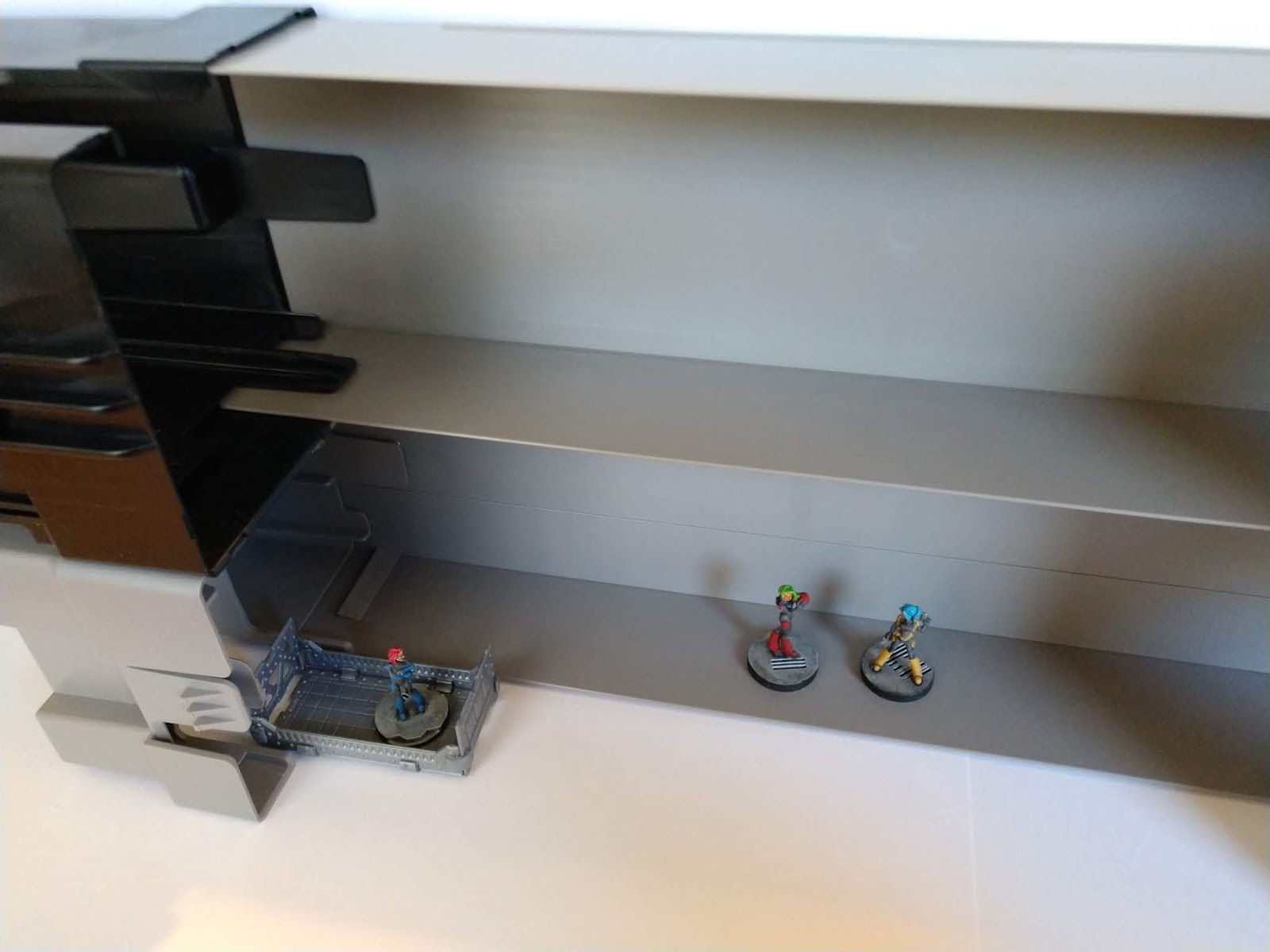
Corridors and tram placeholder with Havoc Girls for scale.

So, the story:

I was scrolling through various sites, researching ideas, and I came across various pictures of futuristic corridors. Some where clean and brightly lit - inspired by the Federations and Empires that like to keep a neat starship. Others were grungy access ways lined with pipes and other industrial details. Some were computer generated, but a few were dioramas with miniatures. And that reminded me of something I had stored away in the garage. What if?

A little rummaging uncovered a box containing plastic pieces from various sources. Each piece caught my eye at some point - an interesting shape that might eventually be the basis for a project. The corridor pictures reminded me of a couple of flat pieces that originally held copier or printer cartridges. The pieces could clip into end caps which I also saved. Now I had an idea of what I could do with them.

Close up of left side end caps. The irregular shapes help convey the feel of a cut-out diagram.

I laid out the pieces on my work table. My original thought was to lay them down with the opening on top. Unfortunately, this made the sides of the corridor too short. Placing the pieces so that the openings were on the side still provided plenty of room for 28mm miniatures. The pieces could be fully detailed on the inside and stacked on top of each other as shown.

The walkways are fairly narrow and long. Some scatter terrain could break up lines of sight.

There is the beginning of a good project here. These pieces could be the basis of an interior spacecraft section or an access tunnel of some distant outpost. It is a little small for a wargaming scenario, but it would make a good diorama or terrain piece for a roleplaying encounter.


Right side view. I'm not sure how I feel about the asymmetrical look.

Trams could run through the open area on the side. I threw together a placeholder freight tram piece from some leftover Hexagon Construction Set parts to demonstrate the concept. Trams like these could provide rapid transit through whatever complex or spaceship that these corridors run through. The original Half-Life game used the concept to good effect.


Close up of tram placeholder.

It would take awhile for me to get from where I am now - the concept phase - to something complete enough to put on the table. These pieces need to be sanded down and cleaned up before I can add details. And I need to go through all my bits boxes to find enough details - doors, cardboard and plastic tubing for pipes, bulkheads, ladders, hatches, and all kinds of greebles for the those smooth surfaces. Then comes clean up, assembly, priming, and painting.

Unfortunately, I've got no time to work on it now. Nothing to do but store it for later. This post will serve as my project notes when I get the time for it.

*Sigh.*

Saturday, July 27, 2019

Star Trek Adventures - A Look at Disciplines

This post continues with the insights gained from our USS Yamato campaign. I passed on some experiences previously when I described the USS Yamato campaign and discussed retooling the campaign with a new ship and mostly new crew. The notes that these posts are based on should provide enough material for a couple more "lessons learned" posts. After that, I'll likely clean up and publish my notes for 2371 and then move on to the retooled campaign. There might be some non-Star Trek Adventures posts in there as well.


Finally got around to putting all of the Divison books together to form this image. They're in a heap of trouble, aren't they?

Let's take a look at Disciplines. For those not familiar with Star Trek Adventures, each character has six Disciplines representing their training in various areas. These are Command, Conn, Engineering, Security, Science, and Medical. Naming the Disciplines after the departments on a Federation starship is no coincidence. It reflects the game's default assumption that the player characters are Starfleet officers. Having those names right on the character sheets help to maintain the feel of playing in the Star Trek setting.

Having six Disciplines instead of a more traditional skill system is an inspired touch. It simplifies character generation by not requiring the players to go through a long list of skills to figure out what they want their characters to be able to do or what they are good at. (Note that players still have to pick six Focuses, which represent what the character is really good at.) Disciplines also streamline play - a gamemaster and player don't have to review a skill list to see which one fits the Task that the player wants their character to perform. Instead, they just have to pick which of the six Disciplines represents the training that the character needs at the moment.

Applying Disciplines is usually straightforward:

  • Issuing orders, engaging in a little diplomacy, or dealing with a Byzantine bureaucracy? Command.
  • Navigating a dense debris field in a starship? Conn.
  • Navigating a dense debris field in a shuttle? Still Conn.
  • Fixing that sparking and smoking console? Engineering.
  • Need to use a handheld phaser? Security.
  • Need to use the ship's phaser array? Still Security.
  • Waving a tricorder at something weird and getting exposition to advance the plot? Science, unless its alive and then it might be Medical.
  • Finding the cure to those strange rashes that everybody's broken out with? Medical.

A few Disciplines have applications that can seem a little odd at first glance, but work well in play:

  • Command covers a wide range of personal interactions, not just leadership as the name implies. A player who wants a character who is charming, relies on salesmanship, or is the Ship's Counselor needs to put points into Command even if they won't be a leader.
  • Conn doesn't just deal with operating vehicles, it also represents a character's EVA training (including the use of spacesuits and moving around in microgravity), ship recognition skills, and familiarity with Starfleet culture. That last could be described as "military protocol" - how to act towards other individuals depending on their relative status in Starfleet, who does what on a starship, and other organizational knowledge. Note that knowledge of specific Starfleet rules and regulations is part of Command.
  • Security covers law enforcement and tactical skills like moving with stealth in addition to weapons use. Investigations usually fall to the Security Chief when a mystery episode shows up in the various Star Trek series. Questioning witnesses, examining evidence, and interrogating suspects all fall under Security.

Let's suppose a player wanted a character who has an affinity with computers but is totally not a hacker. Pretty much all the player would have to do with Disciplines is put three to five points into Engineering. Making sure that Science isn't their dump stat might help with the more theoretical aspects of computing, but that's as much as the player needs to do with Disciplines. The player can then move on to other aspects of their character that would be helpful to a cyber information specialist.

Now, our computer specialist is going to end up highly qualified in other technical areas due to that moderate to high Engineering Discipline. It might seem odd to some to see a character who spends their days working on the ship's data networks suddenly tearing into the warp drive for emergency repairs. This actually fits the setting. Starfleet officers are usually depicted as extremely well trained in a wide variety of skills. However, even our computer specialist has a minimal number of points in one or more Disciplines. No one can be good at everything and Starfleet expects its crews to operate as teams.


Next Time: Our computer specialist gets into trouble.

Thursday, July 18, 2019

Different Places, Different Methods - Starfleet Officer Rosters Depending on Circumstance

This is the third post looking at the senior officer roster of a starship and its effects on a Star Trek Adventures game. The first post described our experiences with using the senior officer roster to guide character creation as we retooled our campaign. The second examined how that roster differs depending on era by looking at different starships named Enterprise. This time, let's see how that roster changes by circumstance.


Deep Space Nine

The following list reflects Deep Space Nine's senior officer roster as of the beginning of 2371, shortly after the arrival of USS Defiant to the station. Note that Worf does not transfer to DS9 until 2372 and Michael Eddington is present. Also note that Benjamin Sisko still holds the rank of Commander until his promotion to Captain in "The Adversary" - the last episode of DS9's third season. Jadzia Dax and Julian Bashir are promoted in between seasons three and four. Finally, this list does not include notable residents of the station such as Quark or Elim Garak.

Commanding Officer Benjamin Sisko
Executive Officer/Liaison Officer Kira Nerys
Chief of Security (Starfleet) Michael Eddington
Science Officer Jadzia Dax
Chief Medical Officer Julian Bashir
Chief of Operations Miles O'Brien
Chief of Security (Station) Odo

There is much to unpack here, so let's dig right in:

  • Starfleet did not provide officers and crew for USS Defiant, instead having Deep Space Nine operate the starship as a support vessel.* Officers and crew are drawn from Deep Space Nine as needed. Most of the senior officers retain their posts from the Deep Space Nine roster. The exception is Jadzia Dax, who takes on the post of CONN in addition to her science duties. In a campaign based on a station or planet, this could be a useful guide for using a Defiant-class, Nova-class, or other small starship to get the Main Characters away on occasion. It doesn't add a bunch of characters to the game and an adventure in space or on an unexplored world makes for an exciting change of pace.
  • Two of the officers, Kira Nerys and Odo, are members of the Bajoran Militia rather than the Federation Starfleet. This arrangement is not unusual for Starfleet. The 24th century Starfleet runs an Officer Exchange Program to improve cooperation with allied governments. This allowed officers of the Klingon Defense Force and other allies to serve on Federation starships. There is also the Interspecies Medical Exchange of the 22nd century, although this is limited to medical personnel as the name implies.
  • Benjamin Sisko, in addition to commanding the station, is the Federation's and Starfleet's representative to the Bajorans. Likewise, Kira Nerys represents the Bajoran Provisional Government (later the Bajoran Republic) and the Bajoran Militia as Liaison Officer. This reflects Starfleet's role in Federation diplomacy and Sisko's mission to facilitate Bajor's joining the Federation.
  • Michael Eddington is assigned to Deep Space Nine in early 2371 to give Starfleet more direct control over station security. (Yeah, I know. IRONIC. And HILARIOUS.) This was over the objections of Benjamin Sisko. In the end, Eddington's role will be limited to overseeing security over Starfleet operations on Deep Space Nine and acting as Security Chief on USS Defiant. General station security, including law enforcement and customs duties, will remain in the hands of Odo and his deputies. Defense of the station from boarding operations remains a shared responsibility. This is an example of Starfleet overriding the concerns of a CO in order to pursue its own agenda. Having Starfleet drop someone in who just doesn't click to provide some drama is fairly common in Star Trek.
  • The inclusion of a Science Officer on the senior staff is curious, given that it is no longer a standard bridge post aboard starships by the late 24th century. It may reflect the fact that a station is less likely than a starship to have a full staff of Science personnel, including specialists in various fields. A station's Science Officer may be a generalist making do with limited resources.*
  • Deep Space Nine's Chief of Operations is responsible for keeping all station systems in good condition. This task is complicated by Deep Space Nine incorporating technologies from three sources - the Cardassians, the Bajorans, and the Federation. Bajoran and Federation technology don't seem to have any particular issues with each other, but Cardassian technology is specifically and repeatedly mentioned as being incompatible with Federation technology. The closest equivalent starship post would be Chief Engineer. This makes Miles O'Brien, a non-commissioned officer, a curious choice for the post, especially after he effectively becomes Chief Engineer of USS Defiant.* This also implies that Deep Space Nine's entire Operations staff is also non-commissioned personnel. (Yes, a junior officer is expected to listen to a more experienced NCO in that NCO's field of expertise, but would not be assigned to routinely follow that NCO's orders. That's the role of a more senior commissioned officer.)

USS Voyager

This list represents USS Voyager's original senior staff as assigned by Starfleet.

Commanding Officer Kathryn Janeway
Executive Officer (No canon first name available. See below.) Cavit
Chief of Security Tuvok
Chief Engineering Officer (No canon name available. See below.)
Chief Medical Officer (No canon name available. See below.)
Flight Control Officer (No canon first name available. See below.) Stadi
Operations Officer Harry Kim
Observer Tom Paris
  • Several of USS Voyager's senior officers are only seen in Voyager's pilot episode "The Caretaker" and names are hard to come by. The XO and CONN have no first names in canon. The CMO is not named in the script or dialogue but does appear in the pilot. Non-canon sources give him various names, but not a consistently used one. The Chief Engineer never even makes an appearance. All of these characters are literal place holders for those that would replace them early in the series and are rarely mentioned later. A note for gamemasters - take a moment to give every NPC a full name, just in case it comes up. It lends a little verisimilitude to the setting.
  • The Ship's Counselor post on USS Voyager is vacant. The ship's initial assignment of capturing Val Jean and arresting its crew is expected to be too brief to require one.*
  • Security Chief Tuvok is on an undercover assignment at the time of USS Voyager's launch. He may not have even come aboard the ship until it gets to the Delta Quadrant. Missing USS Voyager's fitting out and shakedown means that he also missed the chance to familiarize himself with the ship and his Security personnel. Janeway may have been willing to make this trade off, but it does seem odd that no one else was available to take on the undercover role.* A special assignment like this would provide a good reason for a Main Character to disappear for awhile if the player controlling them has to miss a few sessions.
  • Harry Kim is the most junior member of the senior staff in terms of rank and experience. This contrasts with his role as OPS, where he would have to be able to speak with authority on scientific and technical matters as Data did on Enterprise-D. Then again, perhaps a more experienced officer was simply not available.*
  • Tom Paris is not a formal member of the crew. He is aboard for his knowledge of the Badlands, the Maquis in general, and Chakotay's Maquis cell in particular. Observer is a good way to introduce an officer who has a limited role for a specific mission, but is will not be staying around for long.

The following is a list of USS Voyager's senior staff after a short time in the Delta Quadrant. The original XO, Chief Engineer, CMO, and CONN were killed when USS Voyager was swept into the Delta Quadrant. The crews of USS Voyager and the Maquis raider Val Jean have combined to make the long trip home.

Commanding Officer Kathryn Janeway
Executive Officer Chakotay
Chief of Security Tuvok
Chief Engineering Officer B'Elanna Torres
Chief Medical Officer Emergency Medical Holographic Program AK-1 Diagnostic and Surgical Subroutine Omega 323 ("EMH" and "The Doctor")
Flight Control Officer Tom Paris
Operations Officer Harry Kim
  • The XO and Chief Engineer are Maquis who accepted positions as provisional officers to replace lost personnel. They wear different rank emblems than the rest of the officers. The fact that special rank emblems for provisional officers exist means that there is some protocol for it on Federation starships. A qualified non-Starfleet individual might be offered a provisional officer post in an emergency that resulted in the deaths of key officers. However, it is likely that it is only intended to last until the starship can get back to the nearest Federation base or planet.
  • Chakotay was a Starfleet officer before resigning to join the Maquis. Why Janeway makes him into a provisional officer rather than reactivate his commission is not directly addressed in canon. His time in the Maquis may make this questionable from a legal standpoint. Also, although Chakotay is always addressed as "Commander" in the show, his provisional rank emblem is that of a Lieutenant Commander - the rank of the officer he is replacing.
  • Chief Engineer B'Elanna Torres dropped out of Starfleet Academy after two years of disciplinary issues and never held a commission. Her talents as an engineer prompts Janeway to overlook potential interpersonal conflicts and offer her a post as a provisional officer. While this is an extreme example, it illustrates that a starship CO does have some discretion to look the other way for a promising officer.
  • It is unlikely that Kathryn Janeway would put USS Voyager's EMH in charge of sickbay if she had any other choice. The EMH Mark I is not considered an artificial life form or sentient at this point. This does not rule out a holographic or artificial Main Character in 2371, but some explanation would be needed to fit the setting.
  • Tom Paris is appointed to CONN as he is the best qualified pilot available. As with B'Elanna Torres, Janeway overlooks possible disciplinary issues to make the appointment. He is not a provisional officer and wears regular rank emblems.

* These points may reflect personnel limitations of the 24th century Starfleet. Enterprise-D never seemed to lack for qualified personnel, but service on the flagship would be a highly sought after assignment. Meanwhile, Starfleet seems to have given Deep Space Nine and USS Voyager just enough trained personnel to perform their missions and no more. Then again, if Deep Space Nine suddenly needed an expert, Starfleet could just send them one on a temporary assignment - its not like the station wouldn't be there. Likewise, USS Voyager wasn't being sent on a long term deep space mission - it was bringing in some outlaws for trial.

Sunday, July 7, 2019

New School, Old School - Starship Officer Rosters Over Time

The previous post described how we used the senior officer roster to guide group character creation in Star Trek Adventures. This time, let's look at how that organization differs over time and how that might influence the game.

This is the roster of senior officer posts on a Federation starship as presented last time with the snarky commentary edited out:

Commanding Officer (CO)
Executive Officer (XO)
Operations Officer (OPS)
Chief Engineering Officer ("Chief Engineer")
Chief Security Officer ("Security Chief")
Chief Medical Officer (CMO)
Flight Control Officer (CONN)
Ship's Counselor ("Counselor")

This is intended to be a complete list for the game's default year of 2371. I'm using the term Executive Officer instead of the more often used First Officer since it fits the abbreviation XO, the source material uses the titles pretty much interchangeably, and I happen to like it better. To check the accuracy of this list, let's compare it with the roster of a ship that operated for (most) of that year - USS Enterprise, NCC-1701-D as featured in TNG:

Commanding Officer Jean-Luc Picard
Executive Officer William Riker
Operations Officer Data
Chief Engineering Officer Geordi LaForge
Chief Security Officer Worf
Chief Medical Officer Beverly Crusher
Ship's Counselor Deanna Troi

Enterprise-D has an almost complete roster of senior officers, the exception being a regular CONN. It's no surprise that the flagship is fully staffed. With every senior officer post filled, there were no gaps in expertise. Captain Picard could draw on a variety of views and on a deep well of knowledge on pretty much any subject. A Galaxy-class starship with a full staff of talented personnel led by an experienced captain was a powerful tool for the Federation. This may explain why Starfleet was keen on putting that same crew back into space as soon as it could after the loss of Enterprise-D in late 2371.

Let's take a moment to look at the revolving door that is the CONN post on Enterprise-D. It was filled by Geordi LaForge before his promotion to Chief Engineer, Wesley Crusher prior to his acceptance into Starfleet Academy, and Ro Laren until she ran off to join the Maquis. Otherwise, the Flight Control console was operated by a number of folks who would be considered Support Characters in game. A player character CONN may work better for games featuring starship combat as regular occurrence - Main Characters have better stats and access to the full range of abilities to enhance their effectiveness. My headcanon for the "revolving door" on Enterprise-D is that officers who could meet Picard and Riker's high standards for the post were quickly promoted out of it. Service on the flagship looks good on a young officer's record and Starfleet had a need for highly qualified officers elsewhere.

Shifting back to the 23rd century, we have the senior officers of USS Enterprise, NCC-1701 as featured in TOS:

Commanding Officer James Kirk
Executive Officer/Science Officer Spock
Chief Engineering Officer Montgomery Scott
Chief Medical Officer Leonard McCoy
Senior Helmsman Hikaru Sulu
Chief Communications Officer Nyota Uhura
Navigator Pavel Chekov

There are a number of differences from how things are done in the default year of 2371.

  • Combining the XO with another senior officer post seems to be common practice. Another example is from Captain Christopher Pike's tenure as NCC-1701's CO - Number One, who was XO and operated the Helmsman's console.
  • There is a position for the Science Officer on the bridge in order to directly advise the rest of the senior officers on scientific matters. This responsibility seems to have been split between various other posts by the 24th century, with most of it falling on OPS.
  • Doctor McCoy, in addition to being CMO, is the head of the Life Sciences department, NCC-1701's head surgeon, and seems to have some responsibility over the mental health of the crew in general and the CO in particular. It's not clear how much of that is common practice for the CMO of a 23rd century starship and how much is unique to Doctor McCoy.
  • Operating the ship's flight control systems and navigation are the responsibility of separate officers in different divisions. Combining the two roles into CONN may reflect the increasing automation aboard starships as time goes by. 24th century starships seem to be able to take up much of the burden of flying the ship and plotting a course. It should also be noted that the Helmsman's burden also included operating the ship's weapons during much of this era. Starfleet did experiment with adding a Weapons Officer's console to the bridge during the 2270s, but it seems to be missing from NCC-1701-A.
  • Communications is a role for a senior officer with a console on the bridge. The Communications Officer operates and maintains the communications systems, provides translation when the Universal Translator is not up to the task, and is an expert on codes and encryption. The disappearance of this position by the 24th century may reflect increasing computer control of the communications systems. Opening hailing frequencies and responding to incoming transmissions are mostly done from the Tactical console by the 24th century.

Captain Kirk had a wide range of experts available to consult when needed. However, Kirk lacked a permanent Security Chief during the run of TOS. (Chekov was promoted to the post in the movies featuring the TOS cast.) Perhaps he was unable to find one that met his standards. While Kirk had a high enough Security Discipline to make up for some of the lack, a player group probably doesn't want to fill the Security Chief post with a Support Character. A Main Character would be more capable and works well for a player interested in an action-oriented character.

Moving even further back to the 22nd century, we have the senior officers of the United Earth's first warp five capable starship, NX-01 Enterprise:

Commanding Officer Jonathan Archer
Executive Officer/Science Officer T'Pol
Chief Engineering Officer Charles Tucker III
Chief Medical Officer Phlox
Senior Armory Officer Malcolm Reed
Helmsman Travis Mayweather
Communications Officer Hoshi Sato

There are similarities to the lists of officers who served with Kirk and Picard.

  • Like the 23rd century, the duties of XO are combined with that of another senior officer. There are hints that, even if T'Pol had never boarded NX-01, Tucker would have served as Archer's deputy rather than having an officer serving solely as XO. In this case, it could be simply due to the relatively small crew aboard a NX-class starship.
  • The Armory Officer would eventually evolve into the Security Chief post. The Armory Officer's intended roles seemed to be limited to operating the ship's defensive systems and shipboard security. NX-01 appeared to have little ability to project force on a planet's surface or while boarding another ship until the addition a MACO detachment in 2153. It should be noted that any MACOs aboard a Starfleet ship would be under the command of a MACO officer who answers directly to the ship's CO rather than the Armory Officer.
  • There is no Navigator position on the bridge of NX-01. The Helmsman seems to be responsible for plotting courses, much like a 24th century CONN. The Armory Officer controls the ship's weapons, unlike NCC-1701, allowing the Helmsman to concentrate on getting the ship were it needs to go.

Like the other Enterprises, there is an omission from NX-01's senior officer roster. In the case of NX-01, it has to do with the needs of the crew rather than a lack of capability in operating the ship or in deploying Away Teams - the lack of a mental health professional. The intended mission of the NX-class was deep space exploration. By its very nature, this involves operating for months or years away from the Sol system and any support from United Earth. Ship's Counselors didn't exist yet and the CMO seemed to be mainly concerned with and qualified to address the physical health of the crew. A psychologist would have been handy in managing stress (especially during the Earth-Xindi conflict) and monitoring the mental health of the crew.

Next time: A look at how senior officer rosters can reflect different circumstances by looking at commands not named Enterprise.

Thursday, July 4, 2019

Retooling Our Star Trek Adventures Game

So our Star Trek Adventures campaign has evolved from a "taking stock" to a "we really should decide about how to tweak certain things" to a "let's retool this whole thing to make it run better" kinda situation. To be fair, it was only intended to be a quick test drive of the rules. It taking on a life of its own and running for a whole year was never the plan. At this point, we're all inclined to put what we've learned about this game into a new ship and fresh batch of characters. Besides, just about every Star Trek series so far has gone through a retooling at some point during its run. We're really just emulating the source material here.

I've learned a great deal about running 2d20 in general and Star Trek Adventure's version of it in particular. And I'm looking forward to sharing those insights, but not in the form of recaps and let's plays of specific sessions. It would take some time to reconstruct those sessions from my notes and I'd rather focus on lessons learned - what works and areas to improve on.

Where we're starting - or restarting - the game is character creation. The post-retooling campaign will carry over story elements and gamemaster characters from the USS Yamato campaign. There will be a time skip of about six months of in-game time, taking things from early to late 2371. The retooled campaign will take place on a new starship with a (mostly) new crew.

Our group began character generation with a look at the organization of a Federation starship.

Federation Starship Senior Officer Posts (Circa 2371):

  • Commanding Officer - CO; The Captain, but doesn't necessarily hold the rank/grade of Captain. Sits in the big chair right in the middle of the bridge and uses the Assist and Direct Tasks to tell other people what to do.
  • Executive Officer - XO; First Officer; the Exec. Sometimes has a seat to the right of the CO, sometimes has to find a chair wherever on the bridge. Basically the lite beer version of the CO.
  • Operations Officer - OPS. Sits on the bridge and spouts the scientific and technical exposition offered up by the Science Officers of previous centuries.
  • Chief Engineering Officer - Chief Engineer. Sometimes shows up on the bridge, mostly tinkers around in the bowels of the ship.
  • Chief Security Officer - Security Chief. Glares at people from the Tactical console on the bridge while waiting for a chance to shoot something. Sometimes gets to play gumshoe during mystery episodes.
  • Chief Medical Officer - CMO. Addressed as Doctor rather than by rank. Sometimes hangs around the bridge when sickbay's not too busy. Mostly waits for people to get sick or injured. 24th century medical science has progressed enough to motivate attempts to revive downed Security personnel rather than just declare them dead with a shrug.
  • Flight Control Officer - CONN. Combines the duties of Helmsman and Navigator from previous centuries. Sits up at the front of the bridge with the best sight line to the viewscreen and drives the ship.
  • Ship's Counselor - Addressed as Counselor rather than by rank. Not all starships have a Ship's Counselor aboard. Considering what starship crews go through, having a trained psychologist around to dispense advice is probably a good idea. That and/or a bar.


Of these posts, what was seen on the shows and our experience with USS Yamato indicates that the XO, OPS, and Security Chief tend to be most critical for Away Team missions. In the 24th century Starfleet, most Away Team missions are commanded by the XO rather than risking The Captain. However, this does depend on the ship's culture and the dispositions of the officers involved. OPS is vital to analyzing newly discovered phenomena. The Security Chief is there to deal with any threats to the Away Team. Other officers may or may not be part of an Away Team, depending on the mission, but these three end up going most of the time. My first priority was to divide up the XO, OPS, and Security Chief posts among the three players to insure that each of them had a place on almost every Away Team mission.

We opted to continue to have each player control two characters, something we implemented during the USS Yamato campaign. This gives the players plenty of narrative and tactical control. It also avoids the issue of running scenes where the majority of characters present are controlled by the GM.

The players agreed with my explanation that having the CO and XO being controlled by different players would be better for dramatic purposes. It's challenging to have a player argue with themselves. It also splits up the leadership responsibilities and the blame for things not going well.

They decided early on to not have a player character Ship's Counselor. This may be a duty informally filled by the CMO or a gamemaster character.

Having a player control the CONN officer gave the players direct control of maneuvering the ship. The post was filled by a Support Character in the USS Yamato campaign and it didn't feel as smooth running as a player making the decisions and rolling the dice.

The XO player expressed interest in combining the XO post with another post. Although this is a quirk of how the 22nd and 23rd century Starfleets ran things, it does simply the organizational chart. In this case, the XO post was combined with the CONN officer. By combining the posts, the total number of senior officer posts were reduced to six, giving the players control over all of them.

A couple of players expressed a desire to carry over characters from USS Yamato to the new starship. The six month time skip justifies reworking these characters as desired as long as the character concept is kept intact. In rules terms, this means swapping out Focuses, Talents, and Values that really didn't work out the first time around for more promising ones. By doing so, the players are able to use their greater knowledge of the game system to improve their characters. One of the characters also had a couple of points shifted around in their Attributes and Focuses to better suit the new role the character will be filling on the new ship.

Next time: Modifying the list of Senior Officer Posts for other time periods.

Sunday, March 31, 2019

Let Me Tell You About The Game I'm Running - Star Trek Adventures

My roleplaying group is about a year into our Star Trek Adventures campaign. We game slightly less than once a month due to the demands of real life and the challenges of scheduling. Even less than a dozen sessions in, it seems like a good time to take stock.

A team of the Emperor’s finest cleanse a space hulk of filthy xenos! Uh… I mean, a Starfleet Away Team explores a mysterious asteroid ship.

The original idea was for me to run a few sessions to try out the game. Each session would focus on different aspects of the rules. By the end of a few sessions, we would be familiar enough with the game to start a "real" campaign. Our "shakedown cruise" gradually turned into the campaign that we would be playing long term.

The notion of a Star Trek game was a natural for our group. All of us were Star Trek fans and were very familiar with the setting. Most of us had played previous Star Trek roleplaying games. Interest remains high.

Our campaign is centered around USS Yamato, an Akira-class starship that continues the legacy of the Galaxy-class USS Yamato lost in 2365 (in the Star Trek The Next Generation episode "Contagion"). The Akira-class is a fan favorite since its first appearance in Star Trek First Contact. As a cruiser, an Akira-class starship allows for a diverse range of missions compared with a smaller, more specialized ship class like a Nova or Defiant. The Akira-class was also chosen due to the player's desire for a modern starship. The name is a nod to the anime Space Battleship Yamato. These decisions were made collaboratively by the group, rather than by me as the gamemaster. This follows the rules presented in the core book.

The player characters started the campaign as newly assigned bridge officers - the captain and the heads of the science and security departments. This places control of USS Yamato firmly in the hands of the players. I am familiar with the concept of running the captain as a NPC in order to retain greater narrative control and avoid interplayer conflict, but do not favor the practice. The members of my group are all mature and experienced roleplayers. They recognize the difference between the level of authority a character has in a fictional setting and the level of cooperation needed in a roleplaying group. As gamemaster, I have plenty to do without having to run a character who is in most of the scenes. Finally, having orders arrive from Starfleet provides enough direction for the group to follow.

Over time, we found that having only three player controlled characters was a hindrance. Even though the players had characters in critical roles, not every Player Character would be in every scene. Even the flexibility offered by having players control Supporting Characters during such scenes only went so far. The small number of Player Characters also had an effect on starship combat, as the number of actions the ship can take is keyed on the number of Player Characters. Talking it over, we decided to give each player control over two Player Characters. This expanded the roster of Player Characters to include the first officer and the heads of the medical and engineering departments. This opens up other approaches to problem solving and helps insure that each player has at least one character in every scene. This also allowed me to split up the action between events happening in different locations. For example, the captain remaining on the ship with members of the bridge crew while the first officer is leading an Away Team on a planet. This approach makes it easier to emulate the shows by introducing a "B plot" to the session, but does involve some juggling back and forth.

The campaign opens in the game's default year of 2371. USS Defiant has yet to return from its first mission into the Gamma Quadrant and USS Voyager is still being fitted out at the Utopia Planitia fleet yards. USS Yamato has been assigned on a patrol mission along the recently established Demilitarized Zone along the Cardassian border. Sending an Akira-class starship into the area is part of Starfleet's response to the emerging Maquis and Dominion threats. Captain Kerensky also receives classified orders to deploy probes into the Badlands in an effort to gather navigational data and intelligence on Maquis activity. This information will be of great value for Starfleet's plans to counter Maquis operations later in the year. On the way to Deep Space Nine, USS Yamato is notified that USS Equinox has been reported as lost. USS Yamato's course takes it along the outer edge of the search area. Captain Kerensky issues orders to maintain a watch of any signs of the science vessel.

Naturally, none of this goes to plan.

The search for USS Equinox turns up another Starfleet distress call - this one close to a century old. Following up, USS Yamato discovers a crippled Archer-class scout ship - USS Agincourt. The scout ship's warp drive, communications, and other systems were badly damaged by fission warheads and the corpse of the science officer is found on the bridge. USS Agincourt's logs indicate that the scout ship was attacked while investigating a primitive sublight ship built into an asteroid. After the deaths of the captain and first officer, the science officer ordered the crew to take refuge on the asteroid ship while she went for help. Taking USS Agincourt into their shuttle bay, USS Yamato backtracks along USS Agincourt's course. The similarities to the Yonada - an asteroid ship encountered by Captain Kirk's USS Enterprise - are noted, but this asteroid ship is from a different technological base. The asteroid ship soon looms on the main bridge viewscreen. Would any of USS Agincourt's crew have survived after nearly a century? What kind of civilization built the asteroid and what welcome do they have in store?

And I'll leave it there. I'm not going into detail about every session, but that example offers a good feel for the game we are playing. There is little point to using a licensed setting like Star Trek and not getting into the lore. Briefing the characters about the situation near Bajor gives the players a firm idea of when the game is happening. Name dropping Deep Space Nine and USS Equinox fixes where the game is taking place. The Archer-class scout ship is an expanded universe ship from the original series era. The decisions are up to the players, but they know that following the bread crumbs - the century-old distress call, USS Agincourt's logs - will get them to the fun stuff sooner. Besides, their patrol mission was not time sensitive and starships divert from assignments to investigate unexpected situations quite often in the shows.

Monday, December 24, 2018

My Favorite Things - 2018

The end of the year is as good a time as any too take a look back. As I've found more time and energy for my hobbies, I've run across more things that I'd like to share. Below are five noteworthy things that I'm happy to recommend. As this is a tabletop gaming blog, all of them have a connection to that theme, even if it is a pretty tangential one. The list is in no particular order.

A gamemaster's work is never done.

Star Trek Adventures

Some may find the following statement to be heretical: Modiphius Entertainment's Star Trek Adventures is currently my favorite Star Trek role playing game. The game was created by fans for fans and does something that many licensed games fail to do - convey the feel of the setting. The writing assumes that the reader has a working knowledge of Star Trek. This means that the word count saved by not having to explain things like "what the Borg are" can be used for "how the Borg are going to ruin the player characters' day" and other stuff that is useful in play. The streamlined version of Modiphius' 2d20 system implemented in the game provides a strong mechanical framework without being cumbersome. The rules are also flexible enough to allow for some tinkering without too much effort from the gamemaster. I had fun trying it out as a player and am having a great time running the voyages of USS Yamato for my group.

Sharpies in Metallic Silver and Gold

Painting small details has always been a challenge for me and my hands aren't as steady as they used to be. The marker and its firm tip seem to be easier for me to control than a fine detail brush. Additionally, the reflective metallic color is as good as any acrylic metallic paint I've used. These came to my attention thanks to Adam Savage's Tested (see below). He uses the silver version to weather props - a little applied to the edges simulates bare metal showing through worn paint. In addition to that, I've started using them to pick out metallic details on miniatures and terrain pieces. Even better, I've found out that Sharpie also offers metallic bronze, sapphire, ruby, and emerald.

Ken and Robin Talk About Stuff

I listen to many, many podcasts while driving around. This one rarely fails to inform and entertain me. Kenneth Hite and Robin Laws cover a wide variety of subjects including, but not limited to: tabletop gaming, history, food, the occult, and all things Lovecraftian. Their knowledge as game industry veterans shows through in their conversations about rules mechanics and game development. They aren't speculating as relative outsiders, they are laying out facts drawn from decades of experience. Their discussions on game design and gamemastering advice have greatly improved my own understanding and skills. The history segments - usually presented as time travel scenarios - promise to be handy for a campaign I'm planning to run down the road. And their cooking segments have given me a few things to try in the kitchen! Odds are that there will be something of interest in a given episode.

Chupacabracon

Chupacabracon is a local roleplaying game convention and Chupacabracon V the was the first tabletop gaming convention of any kind that I've attended in awhile. Although I wasn't able to attend the whole weekend, it was good to get out again. I discuss my experience in more detail here, but the short version is that I enjoyed the chance to meet folks outside of my regular gaming circle. I'm looking forward to attending again next year!

Adam Savage's Tested

I usually listen to the podcasts from Tested, but their videos have been inspiring and helpful as I work through my pile of unfinished miniatures and terrain pieces. Both their podcasts and videos cover a range of nerdy topics - science, nature, technology, the latest in geek entertainment, and the hosts' most recent "builds" or other projects. While Adam Savage - the same one from Mythbusters - mainly works on props and costumes, his work on those and on models has informed my approach to tabletop miniatures and terrain. He freely offers up tips and tricks that he's picked up from his long career in the special effects industry. Plus, he's generally got something cool to see or hear about in the works!

Sunday, December 16, 2018

Sci-Fi Landing Pad and Shelters

This is a sci-fi terrain project that I completed a few weeks ago - a landing pad with elevator access and a trio of shelters. The goal was for a set of buildings that would fit a variety of themes and backgrounds. Anything from a military outpost to a industrial site to a colony could make use of a landing pad. The shelters likewise could represent any general purpose building. The overall appearance of these terrain pieces are intended to be generic. They would not look too out of place in Star Wars, Star Trek, or most other space opera settings.


Finished landing pad and shelters. 15mm ARC Fleet troopers for scale.

All parts were from a pair of Hexagon Construction Sets from Pegasus Hobbies. My understanding is that the sets are scaled for 25mm, but they fit well with 15mm figures. I played around with these sets in a couple of posts from before my gaming interregnum, including a previous version of the landing pad and a missile silo concept. The final version of the landing pad replaces the rather flimsy ramp of the concept version with an elevator shaft. The doorways of the landing pad elevator and the shelters feature covered areas for additional protection from hostile environments. These porches were added to give the buildings a little more character and to make the locations of the doorways more obvious during play.

Construction Stage: This basically consisted of test-fitting various configurations until I found the ones I most liked. This stage actually benefited from my time away from tabletop gaming - I took these pieces out whenever I was bored and these versions slowly evolved. For example, the shelters were originally more squared off, but the "space quonset hut" developed as I played around with different configurations. I considered reinforcing the clips used to hold the parts together with glue, but rejected the idea as not worth the trouble.

Primer Stage: I used two layers for priming. A dark gray spray primer to the underside and a light gray primer sprayed at an angle to the top. This was intended to simulate shading from an overhead light source.

Base coat only. Note how flat the color appears.

Base Coat Stage: A couple of thin layers of Krylon ColorMaster Paint+Primer Iris Satin. I left a little dark gray primer showing on the underside areas to simulate shading.

After both layers of dry brushing.

Dry Brush Stage: Two layers - one a light blue and a thinner layer in pure white. This brought out the raised details like the rivets.

Detailing Stage: Gold and Silver Metallic Sharpies were used on some of the raised details to break up the blue base color. This was my first experience using Sharpies on a terrain or miniature project. Using Sharpies seemed more precise than a brush for these kinds of small details. Even so, I did manage to get some metallic color in areas that I did not want it in. This was easily fixed with a little blue paint.

Rear view of one of the shelters after detailing and wash layer.

Wash Stage: A mix of Liquitex Soft body in Payne’s Gray, Liquitex Matte Medium, and water was applied in two layers - one to the underside and one to the top. The wash was applied in heavy layers. I used a sponge to remove any excess wash and prevent pooling on the flat surfaces. The wash brought out the recessed details, evened out the overall color of the pieces (the dry brushing was a little uneven in areas), contribute to a more weather appearance, and - most importantly - to hide minor errors from earlier stages.

I’m looking forward to putting these pieces on the tabletop!

Sunday, October 7, 2018

Asteroid Ship Corridor Encounter

Initial test set up of the asteroid ship interior. This configuration ended up as the first area. Note my helpful assistant being helpful.


This post describes a set of encounters that I ran for our Star Trek Adventures campaign a few months ago. My hope was to present the players with an exciting and visually interesting session. My other goal was to provide some motivation to make more progress on the pile of miniatures and terrain that I've purchased over the years.


Background

The player characters' vessel - USS Yamato, an Akira-class starship - was investigating a century-old Starfleet distress signal. The trail led to an enormous sublight ship constructed from an asteroid. The asteroid ship was similar in principle to, but clearly of different origins from, the world ship Yonada from "For the World is Hollow and I Have Touched the Sky" (TOS). The player characters had reason to believe that Starfleet personnel in cryogenic stasis were aboard the asteroid ship. Unfortunately, the dense rock of the asteroid and the materials used to turn it into a functioning spaceship were interfering with USS Yamato's sensors. An Away Team mission would need to board the asteroid ship to investigate further. Naturally, the Away Team deployed from USS Yamato was composed for the player characters - the Captain*, the Science Officer, and the Chief of Security.


*TNG establishes that starship captains do not lead Away Teams, but DS9 and Voyager tend to ignore the idea. Since this was very early in the campaign, I preferred to have the player running the Captain use his character rather than putting him into the shoes of the First Officer or other Supporting Character. My justification for the purposes of the campaign was that the relevant regulation existed, but was sporadically enforced.


Planning phase. Always need coffee for the planning phase.


Rules Overview

Once aboard the asteroid ship, the Away Team found that their tricorders were limited to short range due to the same factors that interfered with USS Yamato's sensors. Tricorder scans also lacked definition - the operator was able to detect that something unusual was in a given location, but could not identify it without further analysis. Communications between the Away Team and USS Yamato were also degraded. It was quickly determined that the amount of static would increase as the Away Team ventured deeper into the asteroid ship, but that contact would not be lost entirely.


The rules were fairly simple. After the corridor board was set up and the miniatures representing the Away Team were placed, the Science Officer would roll for their tricorder scan. The scan would reveal anything of interest within short range. Technological items such as data terminals and cryogenic stasis tanks detected by the scan would be placed on the board. Biological sensor contacts would be represented by "blip" tokens placed on the board. The Science Officer could select a blip token and use each success rolled to determine its exact nature. A given blip could be revealed to be anything from the corpse of an asteroid ship crewmember to a group of alien predators to a type not previously encountered. A new board was set up when the Away Team entered another area of the asteroid ship. There were two boards set up in total.


Data terminals could be accessed to gather information about the asteroid ship. However, extensive security protocols limited access to the asteroid ship's data networks.


Cryogenic stasis tanks could hold a member of the asteroid ship's crew or a long-lost Starfleet officer.


Corpses of the asteroid ship crew littered the corridors. The corpses showed signs of predation.


Running into a group of predators resulted in a combat encounter. Curiously, the predators showed signs of a communal intelligence that communicated through the use of natural radio transmitter/receivers. The predators were clearly of different biological origin than the asteroid ship crew.


Test set up of the second area of the asteroid ship. Note the closed doors blocking free movement of the critters (represented by "blips") and the cryogenic stasis tubes.


Inspiration


The encounter was mechanically inspired by Star Trek Adventures' rules for gathering information. Each successful result behind what is needed to succeed at such a Task allows the player to ask a question of the gamemaster. In this case, each additional success allowed the Science Officer's player to ask what each "blip" token represented. Within the context of the game setting, this reflects the Science Officer's efforts to use her tricorder to dial in on a specific sensor contact.


Visually, it was inspired by a certain board game about investigating a massive derelict in space. The board game is based in a certain grimdark space fantasy setting where there is only unending military conflicts and endless debates over what is considered canon. That board game was, in turn, clearly inspired by the second installment of the "Alien" movie franchise.


The full set up of the first area during actual play. The Away Team just cleared this section of the asteroid ship and are preparing to press on.

Miniatures and Terrain Sources

The asteroid ship interiors area single set of Creative Gamescapes Spaceship X modular spaceship corridor tiles. As shown, the tiles are not in a complete state. They are assembled with a silver basecoat and a layer of wash, but still need some work. I intend to write a separate post on them when I finish that project.


The Away Team was represented by Effigy Miniatures' Havoc Girls. They were featured in a post earlier this year.


Litko Scanner Blip Tokens, Fluorescent Blue were used for the tricorder contacts. In retrospect, green might have been more thematic.


The alien predators prowling the corridors of the asteroid ship were represented by the Parasachnid Warriors from Khurasan Miniatures. They are featured in their own post.


The data terminals were Warsenal's Access Terminals. They were featured in a post from April.


The cryogenic stasis pods were a "trash bash" built from bits I had in storage. See this post for details.


The crates and other small terrain pieces scattered along the corridors were Spartan Scenics Warehouse Accessories. They were featured in a post from way back in 2015.


Wrapping Up


The encounters worked as designed and were well received by the players. I was also happy to get a few more painting and assembly projects completed. Having an immediate use for specific miniatures and terrain helped to maintain my focus.